By Deepti Dhoot
June 2026
India’s rooftop solar revolution is beginning to transform residential neighbourhoods across the country. Electricity is a costly affair, and with prices rising steadily hovering between 6-8% per annum, it results in higher energy bills. An increasing number of households are switching to rooftop solar as a viable and pocket-friendly option owing to government schemes, a dramatic reduction in the cost of solar panels, and the willingness of the Indian middle class to pay for solar panel installations on their rooftops.
Scale of the Shift
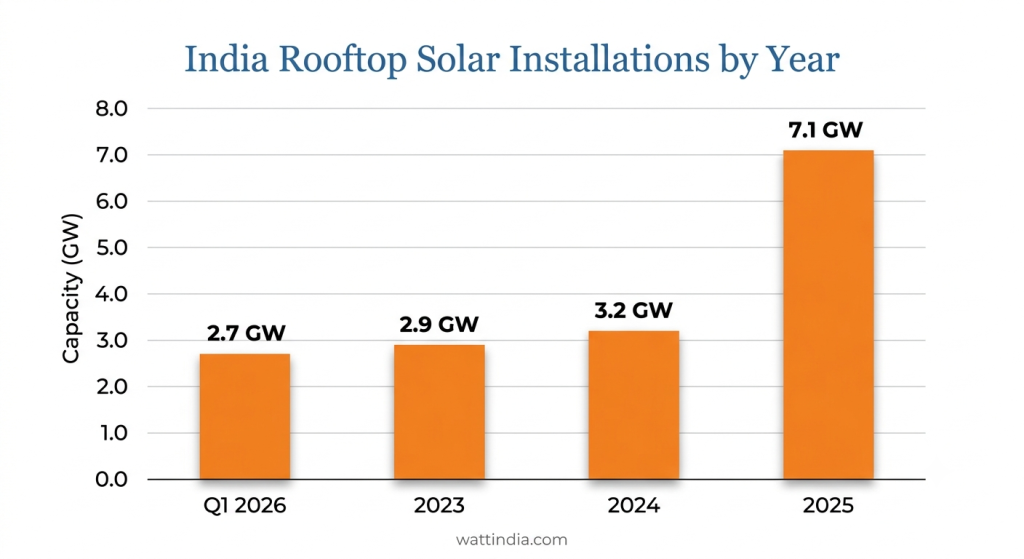
In 2025, residential consumers accounted for 76% of total rooftop installations in India, and this number rose to 82% in the first quarter of 2026. These figures are purely from residential households.
At the centre of this transition is the ambitious PM Surya Ghar: Muft Bijli Yojana programme (PMSGY). It was launched in 2024 with the aim of adding ten million households by 2027 and with a budget outlay of Rs 75,021 crore. According to the Ministry of New and Renewable Energy’s PM Surya Ghar Dashboard, more than 3.3 million rooftop solar systems have been installed under the scheme, adding over 12 GW of capacity to the national grid. These numbers have helped India surpass Japan to become the third-largest solar power producer in the world, behind only China and the United States. For a tropical country with bright sunshine almost all year round, India is well and truly slated to exceed even these expectations, provided execution keeps pace with ambition.
PM Surya Ghar
The PMSGY is a central initiative aimed at encouraging the adoption of rooftop solar systems across India. It promises the consumer up to 300 units of free electricity per month and is supported by government subsidies for residential solar installations. The objective of this programme is to enable up to one crore homes to generate their own electricity via rooftop solar systems, thereby reducing dependence on conventional grid power and lowering household energy bills.
The Government of India is also offering subsidies to support speedy adoption, which not only significantly reduces the upfront cost of installation but also benefits consumers with assistance and supplementary incentives in several states. For example, some states currently offer additional subsidies on a per-kilowatt basis, making rooftop solar energy even more affordable. The programme’s broader promise is quite straightforward, that is, to lower electricity bills for up to 25 years through self-generated solar power.